Showing posts with label fuel for your body. Show all posts

Sunday, 8 October 2017

Think Fat Loss, Not Weight Loss

Weight loss is one of the hottest topics ever. Everyone seems to be trying to lose weight nowadays. Most diet programs are about weight loss and body weight is often used as an indicator of fitness progress. But, this is an incorrect approach.

Your ultimate goal should always be to lose fat and reducing excess body fat is what you should be concerned about. Weight loss and Fat loss is NOT the same thing! Many people confuse the two terms, often believing that they mean the same, when in fact weight loss and fat loss are very different from one another. This article will help you understand how weight loss is different than fat loss and how fat loss is far superior to weight loss in almost all ways.
Weight loss is not just fat loss


What Is Weight Loss?

(Weight Loss = Muscle Loss + Fat Loss + Water Loss)

Weight loss is attempting to lower your total body weight. It simply refers to a lower number on a scale.

Your body weight is composed of all the parts of your body such as muscles, fat, bones, water, organs, tissues, blood, water etc. When you lose weight, you lose a little bit of... fat, muscle and water.

You lose fat but very little and along with the fat you lose muscle and some amount of water. The higher you reduce your calorie intake, the faster you drop weight and the more muscle mass you lose.

Do know your muscle matters? Loss of muscle affects your health and your overall appearance.
Being fit means more than just fat loss


When you lose weight too quickly, your body cannot maintain its muscle. Because muscle requires more calories to sustain itself, your body begins to metabolize it so that it can reserve the incoming calories for its survival. It protects it fat stores as a defense mechanism to ensure your survival in case of future famine and instead use lean tissue or muscle to provide it with calories it needs to keep its vital organs such as your brain, heart, kidneys and liver functioning. If you reach a point where you have very little fat or muscle, your body will metabolize your organs to keep your brain functioning leading to heart attack, stroke and liver and kidney failure.

As the body loses more muscle mass, the body's overall metabolic rate decreases. The metabolic rate is the rate at which the body burns calories and is partly determined by the amount of muscle you have.

So the more muscle you have, the higher your metabolic rate; the less muscle you have, the lower your metabolic rate and fewer calories you burn. This explains why it is crucial to protect your metabolic rate and not have muscle loss.

Loss of muscle also leads to loss of tone underneath the skin leaving you soft and unshapely with no form or contour. If you lose weight too rapidly, your skin won't have time to adjust either. Also muscle is what gives you strength and loss of it means a weak body.

With weight loss you shrink in size and become a smaller version of yourself with a fragile frame with saggy skin.

Weight loss works in the short run to make you smaller but is temporary, almost everyone rebounds and regains the weight. This forces you to find another diet. And then another one, and another one - because eventually they'll all fail.

What Is Fat Loss?

(Fat Loss = Loss Of Stored Body Fat)

Fat loss is attempting to lower your total body fat - i.e. the percentage of your total body weight that is made up of fat.

The right approach for fat loss is to exercise smartly and
Eat the right food to have the right body
eat intelligently in a way that maintains muscle and focuses on fat loss exclusively.

The muscle you have is not there forever. If you don't feed it and don't use it - you lose it. A proper plan with right combination of resistance and cardiovascular training with adequate progression and a right nutrition plan to support it can help you achieve this. Exercise only boosts the burning process but doesn't just melt the fat away on its own - if you do not create a deficit and feed the body too much - it won't touch the stored fuel reserves. On the hand if you drastically cut your calories and do not feed your muscle properly or don't exercise and use your muscle, you will lose it. Fat loss is about finding that right balance.

With fat loss you maintain the muscle and keep the metabolic rate running high. You also develop stronger connective tissue, tighter skin and stronger bones and joints. With fat loss you transform your body.

Fat loss is a lifestyle approach where you give your body what it needs without depriving and shocking it with threat of starvation. You get to see slow but permanent steady progress.

It may sound odd, but it's possible to get thinner without actually seeing a change in your weight. This happens when you lose body fat while gaining muscle. Your weight stays the same, even as you lose inches.

Lets see how this happens.
Muscle uses less weight than fat


Fat tissue is very loose and not dense. It occupies a lot of space in your body. Whereas muscle is more dense and takes up less space. When you lose fat, this space is freed and you can notice inch loss. If you are following a consistent strength training program then gain in lean muscle tissue will balance out this loss of fat and weight stays the same. Since muscle takes less space than fat, you lose inches and start to look more toned, lean and shapely.

consistent strength training program then gain in lean muscle tissue will balance out this loss of fat and weight stays the same. Since muscle takes less space than fat, you lose inches and start to look more toned, lean and shapely.

Myth: "Getting fit" means "Losing weight."

Truth: Getting fit means lowering your body fat percentage!

This Article By Written By:
Rashmi V Jolly
Online Fitness Coach & Founder of Body Redesign
Website: http://www.body-redesign.com

Article Source: https://EzineArticles.com/expert/Rashmi_V_Jolly/2240871

Wednesday, 17 August 2016

Wednesday Video - Top 10 Food Myths


These are the (possibly) false truths we convince ourselves to believe in regards to our food. Join http://watchmojo.com as we count down our picks for the Top 10 Food Myths.

Friday, 1 July 2016

Fat Loss Friday - The Many Benefits of Whey Protein Powder

Many people who are looking to get fitter and healthier these days are turning to protein powder to help them achieve their goals. Protein powder, consumed in shakes or bars, can help speed up recovery from exercising, build muscle, and help people lose weight, so there are indeed many attractive benefits to consuming this type of product.

With that said, arguably the most popular type of protein powder on the
Stock up on Whey protein
market today is whey protein, which is often said to be most effective in whey isolate form rather than concentrate. Here are some of the main benefits of whey protein powder for both women and men who are looking to reach their fitness and body goals.

One of the most attractive things about whey protein powder for women and men is that this is often the most affordable type of protein powder on the market today. This means that you can stock up on all the products that you like and need for your workouts for a fraction of the price of other protein powders out there.

The reason behind the popularity of this kind of powder lies simply in the fact that there are also many other benefits to using this particular type of protein, which will be explored later. Due to the popularity of this product, not only is it extremely affordable, but there is also a whole lot of choice on the market in terms of flavours and additional ingredients to choose from.

For those looking for the best whey protein powder for women, this can mean choosing from a vast selection of great products that are especially designed for the female body. This means that they are more adapted to the needs of women, have flavours geared towards women and also have additional ingredients that support women's health.

Another major benefit of whey protein in general is that it is a high quality protein which is very easily absorbed. It contains all of the essential amino acids and is easily digested, meaning that it is a reliable and effective protein source for all kinds of people.

The fact that whey protein powder is such a high quality protein
Whey protein helps the body stay in shape
and is easily absorbed means that the body can put it easily to good use. It is excellent for those who want to build up strength and muscle, and keep their body in tip top shape even though they might be growing older. Those who want to improve their results from strength training will also find whey protein very valuable.

There are also several reputed health benefits of consuming whey protein on a regular basis. These can include lowering blood pressure and treating type 2 diabetes, and several studies have actually given evidence supporting these statements. There are also several other health benefits of this product that have been reported on which provide interesting food for thought.

Lastly, consuming whey protein is an excellent way to reduce hunger and decrease appetite for unhealthy foods, which is a key part of maintaining a great weight loss schedule for those people who are looking to shed a few pounds. Eating enough healthy foods when losing weight is hard, especially with the increased appetite that exercise can cause.

With this said, choosing whey protein powder for women can be great for those whose main aim is to lose weight rather than gain muscle. Those looking to bulk up and improve their strength will also benefit from this particular product however, due to its excellent capacity for helping build muscle.

These are just a few of the major benefits of choosing whey protein as a supplement when integrating a new exercise and fitness schedule into your life. From better health to better results, there are several great arguments why you should give whey a try to see if it makes a difference for you too.


Read more: The Many Benefits of Whey Protein Powder http://www.sooperarticles.com/health-fitness-articles/many-benefits-whey-protein-powder-1495846.html#ixzz49DdMO8Vw
Follow us: @SooperArticles on Twitter | SooperArticles on Facebook

Friday, 26 February 2016

Fat Loss Friday - Ways to Get Your Kids to Eat Better

A nutritionist who's also the mother of 7-year-old triplets gives tried-and-true tips for getting your child to eat vegetables, drink milk, try new foods, and more.

By Julie Burns, R.D. from Parents Magazine


Every single day, I deal with picky eaters both big and small. I'm the mother of 7-year-old triplets, all of whom have very different eating habits; I'm also a dietitian who teaches the professional athletes on the Chicago Bears and Chicago Bulls teams how to improve their diets. Although it's tough to convince a towering basketball player or a 300-pound linebacker that junk food is bad for him, trying to get my kids to eat well can be even more of a challenge. My daughter Kathleen has severe and life-threatening allergies to eggs, peanuts, and tree nuts, and Julia will not eat fresh fruit; luckily, my son, Marty, will try just about anything. Mothers constantly tell me that they feel guilty about their children's diets; they know how important it is to feed their kids healthy foods, but they're just not sure how to do it. Despite my own background in nutrition, I had to go through some trial and error with my triplets. Here are the most important lessons I've learned, which should help you guide your kids to eat better.

1. Make a schedule

Children need to eat every three to four hours: three meals, two snacks, and lots of fluids. If you plan for these, your child's diet will be much more balanced and he'll be less cranky, because he won't be famished. I put a cooler in the car when I'm out with my kids and keep it stocked with carrots, pretzels, yogurt, and water so we don't have to rely on fas


2. Plan dinners. 

If thinking about a weekly menu is too daunting, start with two or three days at a time. A good dinner doesn't have to be fancy, but it should be balanced: whole-grain bread, rice, or pasta; a fruit or a vegetable; and a protein source like lean meat, cheese, or beans. I often make simple entree soups or Mexican chili ahead of time and then freeze it; at dinnertime, I heat it up and add whole-grain bread and a bowl of cut-up apples or melon to round out the meal.

3. Don't become a short-order cook. 
Don't be a short order cook

A few years ago, I got into a bad habit. I'd make two suppers -- one that I knew the kids would like and one for my husband and me. It was exhausting. Now I prepare one meal for everybody and serve it family-style so the kids can pick and choose what they want. Children often mimic their parents' behavior, so one of these days, they'll eat most of the food I serve them.

4. Bite your tongue.

As hard as this may be, try not to comment on what or how much your kids are eating. Be as neutral as possible. Remember, you've done your job as a parent by serving balanced meals; your kids are responsible for eating them. If you play food enforcer -- saying things like "Eat your vegetables" -- your child will only res

5. Introduce new foods slowly. 

Children are new-food-phobic by nature. I tell my kids that their taste buds sometimes have to get used to a flavor before they'll like the taste. A little hero worship can work wonders too. Marty refused to even try peas until I told him that Michael Jordan eats his to stay big and strong. Now Marty eats peas all the time.

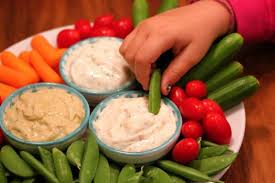
6. Dip it. 
Kids love dipped food

If your kids won't eat vegetables, experiment with dips. Kathleen tried her first vegetable when I served her a thinly cut carrot with some ranch salad dressing. My children also like hummus, salsa, and yogurt-based dressing.

7. Make mornings count. 

Most families don't eat enough fiber on a daily basis, and breakfast is an easy place to sneak it in. Look for high-fiber cereals for a quick fix. Or, do what I do and make up batches of whole-grain pancake and waffle batter that last all week. For a batch that serves five, sift together 2 cups whole-wheat pastry flour, 4 tsp. baking powder, 1/2 tsp. salt, and 2 Tbs. sugar. When you're ready to cook, mix in 2 Tbs. ground flax meal, 2 cups water, 3 Tbs. canola oil, 1/4 tsp. vanilla, and 2 Tbs. applesauce.

8. Sneak in soy. 

Even if your kids don't have milk allergies, soy milk is a terrific source of healthy phytochemicals. My kids don't like soy milk but don't notice when it's hidden in a recipe. I use the low-fat, calcium-fortified kind in some recipes that call for milk, such as oatmeal, mashed potatoes, and sauces.

9. Sprinkle some sugar. 

Julia eats her cooked carrots with a bit of brown sugar, and I mix a little root beer into her prune juice to make prune-juice soda. Kathleen and Marty like a sprinkle of sugar on their fruit. I know that they'll eventually outgrow this need for extra sweetness, but in the meantime, they're eating fruits and vegetables.

10. Get kids cooking. 
Kids love to help out

If your children become involved in choosing or preparing meals, they'll be more interested in eating what they've created. Take them to the store, and let them choose produce for you. If they're old enough, allow them to cut up vegetables and mix them into a salad. Although Julia refuses to eat fresh fruit, she and I make banana or apple muffins together -- and she always eats them once they're done.

11. Cut back on junk. 

Remember, you -- not your kids -- are in charge of the foods that enter the house. By having fewer junk foods around, you'll force your children to eat more fruits, vegetables, whole grains, and dairy products.

12. Allow treats
An occasional treat is fine

Having less healthy foods occasionally keeps them from becoming forbidden -- and thus even more appealing. We call candy, soda, and cookies "sometimes" foods. I generally buy only healthy cereals such as Cheerios and Raisin Bran, but I let my kids have sugary cereals when they visit their grandparents or when we're on vacation. And I treat them to McDonald's for lunch every so often.

13. Have fun. 

The more creative the meal is, the greater the variety of foods my kids eat. We make smiley-face pancakes and give foods silly names. (Broccoli florets are "baby trees" or "dinosaur food.") Anything mini is always a hit too. I often use cookie cutters to turn toast into hearts and stars, which the children love.

14. Be a role model

If you're constantly on a diet or have erratic eating habits, your children will grow up thinking that this sort of behavior is normal. Be honest with yourself about the kinds of food messages you're sending. Trust your body to tell you when you're hungry and when you're full, and your kids will learn to do the same.

15. Adjust your attitude. 

Realize that what your kids eat over time is what matters. Having popcorn at the movies or eating an ice-cream sundae are some of life's real pleasures. As long as you balance these times with smart food choices and physical activity, your children will be fine.

Wednesday, 27 May 2015

Healthy Eating and Recipes For Weight loss


Losing weight effectively is a combination of the following things:

* food selection
* food preparation
* exercise


These three points need to be addressed if you want your weight loss campaign to be successful. If you do not address these three things you may find yourself on a cycle that does not give you the results that you are seeking.

Let's take a look at the importance of each one individually.

1. Food selection:
Food selection and the type of fuel you put into your body is critical to your success. When choosing food to fuel your body and aid weight loss choose natural foods. Eat foods that are as close to their natural state as possible. Stay away from foods that have been processed and refined. Cut sugar out completely as it turns to fat on your body particularly around your waist. Do not drink carbonated drinks or alcohol. Water should be your preferred drink and you can add lemon or lime to give it flavour.

2. Food Preparation: 
Often people choose the right foods and are doing the exercise required yet the weight refuses to budge. The simple reason for this is because they are preparing their food the wrong way. When cooking and preparing meat you must look at healthier alternatives to frying. The preferred methods for healthy cooking for a lean, healthy body are: steaming, blanching, grilling and baking- cooking in these ways helps to retain most of the nutrients and flavour without adding any fat.

3. Exercise: 
Exercise is essential to not only lose weight but to tone your body. Be creative with your exercise routine but aim to do something everyday. Include cardio workouts, as well as weight and strength training to accelerate your weight loss. Pilates and yoga is a fantastic way to strengthen your core muscles and helps to create long lean muscles.

Following the above three rules combined with your specific goals for weight loss will ensure your success.

Article Source: http://EzineArticles.com/?expert=Abby_Burgin